

The book on the table is mine I left it there after reading it last night. Its blue cover and dog-eared pages make it easily recognizable. Please don’t move it, as I need it for my studies later. If anyone sees it, kindly let me know.

Grammatical Structure
- Determiner: “The” → Specifies a particular book.
- Subject Noun Phrase: “The book on the table”
- “book” → Head noun.
- Verb Phrase: “is mine”
- “is” → Linking verb (connects subject to complement).
- “mine” → Possessive pronoun (subject complement showing ownership).
Semantic Meaning
- Implies there may be other books elsewhere (not on the table).
Common Mistakes to Avoid
- → “My” must be “mine” when standing alone (possessive pronoun vs. determiner).
- Ambiguous: “The book is on the table and mine.”
- → Could imply two ideas: location + ownership. Better to combine clearly.
Transformations
- Question: “Is the book on the table mine?”
- Negative: “The book on the table isn’t mine.”
Related Grammar Concepts
- Prepositional Phrases as Adjectives: “on the table” modifies “book”.
- Possessive Pronouns: mine, yours, his, hers, ours, theirs (replace nouns: “It is mine”).
- Definite Article “The”: Signals a specific book (both speaker and listener know which one).
Practice Exercises
- Rewrite the sentence using “belongs to” instead of “is mine”.
- Add an adjective to describe the book.
→ “The red book on the table is mine.”
Syntactic Tree (X-Bar Theory)
- NP (Noun Phrase): “The book on the table”
- PP (Prepositional Phrase): “on the table” modifies “book”.
- VP (Verb Phrase): “is mine” (predicate).
Semantic Roles (Thematic Relations)
- Theme: “The book” (entity being owned).
- Possessor: “me” (implied by “mine”).
- Location: “on the table” (spatial relation).
Pragmatic Implications
Politeness Strategies:
- Softened: “I think that book on the table might be mine?”
- Authoritative: “That’s my book on the table. Do not touch it.”
Phonology & Stress Patterns
- Neutral stress: “The BOOK on the TABLE is MINE.”
Contrastive focus:
- “The book on the table is mine.” (Not the one under the chair.)
Ambiguity & Alternative Parses
- The sentence is unambiguous, but slight changes introduce ambiguity:
- → Does “with a cover” modify book or table? (Garden-path potential.)
Historical/Grammatical Oddities
- Archaic Form: “The book upon the table is mine own.” (Early Modern English)
- Double Possessive: “That book of mine on the table…” (Adds emphasis but is redundant.)

Cross-Linguistic Comparison
- Spanish: “El libro sobre la mesa es mío.” (Identical structure)
- Japanese: “The book on the table is mine.” (Particle-based: “Teeburu no ue no hon wa watashi no desu.”)
Philosophical musing
- Ownership vs. Placement: Does the book being on the table inherently make it yours, or is this a social construct?
- Existential Questions: If no one witnesses the book, is it still “on the table”? (Berkleyan idealism vibes.)
Creative Twists
- Poetic: “Upon the table rests a tome / Its spine, its words, its heart my own.”
- Mystery: “The book on the table was mine—until the bloodstains appeared.”
- Absurdist: “The table is on the book, yet somehow the book is still mine.”
Advanced Exercises
- Transform into a relative clause:
- Merge with another sentence:
→ “The book on the table is mine, but the pen next to it is yours.”
Translate into binary for fun:
- Cognitive Linguistics: How the Brain Processes the Sentence
Conceptual Blending Theory
- Your brain combines two mental spaces:
- “Book on the table” (a physical object in a location)
“Mine” (ownership concept)
- The blend creates a single frame: “An object I possess is located on a surface.”
Image Schema
- CONTAINER schema: The table acts as a base “container” for the book.
- POSSESSION schema: The book is linked to you via an invisible ownership force.
- Discourse Analysis: How the Sentence Functions in Conversation
Given vs. New Information
- Given (known to listener): “The book on the table” (assumes listener sees/agrees on which book).
- New (asserted): “is mine” (new claim about ownership).
Possible Dialogue Contexts:
- Clarifying ownership:
- A: “Whose book is this?”
- B: “The book on the table is mine.”
Rejecting an assumption:
- A: “This must be Sarah’s book.”
- Computational Parsing: How AI (Like Me) Understands the Sentence
Step-by-Step NLP Parsing:
Tokenization:
- [“The”, “book”, “on”, “the”, “table”, “is”, “mine”, “.”]
- Part-of-Speech Tagging:
- “The” → Determiner (DT)
- “book” → Noun (NN)
- “on” → Preposition (IN)
- “is” → Verb (VBZ)
- “mine” → Possessive Pronoun (PRP$)
Dependency Parsing:
- “book” → root
- “The” → det (determiner of “book”)
- “on the table” → prep (prepositional modifier of “book”)
- “is” → cop (copula linking subject to predicate)
- “mine” → nsubj (subject complement)
AI Interpretation Logic:
- Input: A declarative statement about possession.
- Entities Identified:
- Object: book
- Location: table
- Owner: speaker
Knowledge Graph Representation: text
- (Book) —[located_on]→ (Table)
(Book) —[owned_by]→ (Speaker)
Logical Form & Formal Semantics
- Predicate Logic Translation:
Let: - B(x) = “x is a book”
- T(y) = “y is a table”
- On(x,y) = “x is on y”
- Mine(z) = “z belongs to me”
Logical Form:
- (There exists a book and a table such that the book is on the table and the book is mine.)
Psycholinguistics: How a Child Learns This Sentence
- Language Acquisition Stages:
Lexical Learning (1-2 yrs): - Knows “book”, “table”, “mine” as isolated words.
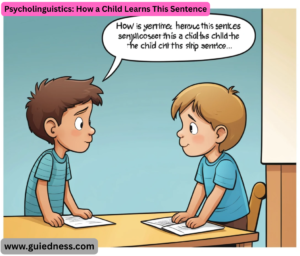
Syntax Development (2-3 yrs):
- Combines words: “Book table!” (telegraphic speech).
- Preposition Mastery (3-4 yrs):
- Adds “on”: “Book on table!”
- Possessive + Copula (4-5 yrs):
- Full sentence: “The book on the table is mine.”
Errors Kids Might Make:
- “Book table my!” (Missing grammar)
- “The book is on the table is mine.” (Double “is” confusion)
Cross-Cultural Variations
- Languages Without “Is” (Zero Copula):
Russian: “Книга на столе — моя.” (No “is” needed.) - Arabic: “الكتاب على الطاولة ملكي” (Implied ownership without verb.)
Languages with Different Possession Structures:
- Hungarian: “Az asztalon lévő könyv az enyém.” (Uses possessive suffix *-ém*.)
Philosophical Extensions
John Locke’s Theory of Property:
- Does placing the book on the table make it yours? (Mixing labor with objects = ownership?)
- Counterpoint: What if someone else put it there?
Borges’ Infinite Library:
- If every possible book exists, is this book truly “mine,” or just one of infinite copies?
- AI & Machine Learning: Training a Model on This Sentence
Dataset Annotation for NLP:
Named Entity Recognition (NER):
- “The [book] on the [table] is [mine].” → (book: OBJECT, table: LOCATION, mine: OWNER)
Sentiment Analysis:
- Neutral statement, but could be defensive if context implies argument.
- Neural Network Interpretation:
Transformer Models (like GPT-4): - Encodes the sentence into vectors, computes attention weights between words.
- Predicts next possible responses:
“Please don’t move it.”
“I left it there yesterday.”
Extreme Sentence Transformations
- Passive-Aggressive Version:
“Oh, so you were using the book on the table? Funny, since it’s mine.”
Legal Document Version:
- “The aforementioned literary artifact, presently situated upon the horizontal wooden surface herein referred to as ‘the table,’ is hereby declared the sole property of the undersigned.”
- Yoda-Speak (OSV Word Order):