

Terrorism It is a global security threat that has caused significant loss of life, instability, and fear worldwide. Governments and international organizations work to combat terrorism through law enforcement, intelligence sharing, military action, and counter-radicalization efforts.

Key Aspects of Terrorism:
- Motivations – Terrorist acts may be driven by extremism, separatism, religious fundamentalism, or political grievances.
- Methods – Common tactics include bombings, shootings, hijackings, cyberattacks, and biological/chemical threats.
- Major Groups – Notable terrorist organizations include:
Al-Qaeda (responsible for 9/11 attacks)
- Boko Haram – Active in West Africa, targeting civilians and schools.
- Taliban – A militant group controlling Afghanistan.
- Hamas & Hezbollah – Designated as terrorist organizations by some countries.
- State-Sponsored Terrorism – Some governments support terrorist groups as proxies (e.g., Iran-backed militias).
Counterterrorism Measures:
- Military & Police Actions – Targeted strikes, arrests, and special operations.
- Intelligence & Surveillance – Monitoring communications to prevent attacks.
- Financial Sanctions – Cutting off funding to terrorist networks.
- Deradicalization Programs – Rehabilitating extremists and preventing recruitment.
- International Cooperation – Organizations like the UN, NATO, and Interpol work together to combat terrorism.
Controversies:
- Human Rights Concerns – Some counterterrorism tactics (e.g., drone strikes, mass surveillance) raise ethical issues.
- Definition Debates – One country’s “terrorist” may be another’s “freedom fighter.”
- Cybersecurity Threats – Increasing use of online radicalization and cyberterrorism.
Historical Context of Terrorism
- Terrorism is not a new phenomenon—its roots trace back centuries:
- 1st–14th Century: Jewish Sicarii assassinated Roman occupiers; Hashashins (Nizari Ismailis) carried out political killings in Persia.
- 18th–19th Century: The term “terrorism” originated during the French Revolution’s Reign of Terror (1793–94). Anarchists (e.g., Russian Narodnaya Volya) used bombings and assassinations.
20th Century:
- Nationalist Terrorism – IRA (Ireland), ETA (Basque Country), PLO (Palestine).
- Left-Wing Terrorism – Red Brigades (Italy), RAF (Germany).
- Right-Wing Terrorism – Neo-Nazi attacks (e.g., Oklahoma City Bombing, 1995).
- 21st Century: Rise of jihadist terrorism (Al-Qaeda, ISIS), lone-wolf attacks, and cyberterrorism.
Psychology of Terrorism
- Why do individuals or groups turn to terrorism?
- Grievance & Marginalization: Perceived injustice (e.g., oppression, foreign occupation).
- Radicalization: Often through online propaganda, prisons, or extremist networks.
- Group Dynamics: Peer pressure, desire for belonging, and charismatic leadership.
- Religious & Ideological Zeal: Belief in martyrdom or a “holy war.”
- Lone Actors: Mentally unstable individuals inspired by extremist ideologies (e.g., Christchurch shooter, 2019).
Modern Terrorism Trends
- Cyberterrorism: Hackers targeting infrastructure (power grids, hospitals).
- Biochemical Threats: Use of poison (e.g., Novichok in Salisbury, 2018) or pandemics as weapons.
- Drone Terrorism: ISIS used commercial drones for bomb drops.
- Far-Right Extremism: Rising in the West (e.g., Capitol Riots 2021, Proud Boys).
- Cryptocurrency Financing: Terror groups use Bitcoin for anonymous funding.
- Racial Profiling (e.g., targeting Muslims post-9/11).
- Mass Surveillance (e.g., NSA leaks by Edward Snowden).
- Collateral Damage (civilian deaths in drone strikes).
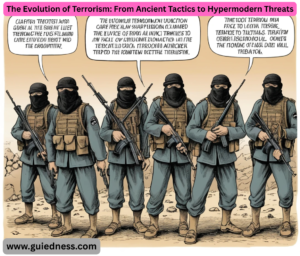
The Evolution of Terrorism: From Ancient Tactics to Hypermodern Threats
Pre-Modern Terrorism
- Assassins (11th–13th century): Shi’a sect used precision killings to destabilize Sunni rulers.
- Thuggee (India): Ritual stranglers worshipped Kali; suppressed by British in 1830s.
Modern Terrorism (1960s–2000s)
- Left-Wing Waves: Red Brigades kidnapped/killed Italian PM Aldo Moro (1978).
- Airline Hijackings: PFLP’s 1970 Dawson’s Field hijackings led to modern airport security.
Fourth-Wave Terrorism (Post-9/11)
- Decentralized Jihad: ISIS’s “remote radicalization” via Telegram, inspiring lone wolves.
- Weaponized Social Media: Livestreamed attacks (Christchurch) create viral terror.
The Economics of Terrorism
Funding Streams:
- Kidnapping Ransoms: Al-Qaeda earned ~$125M (2008–2013).
- Illicit Trade: ISIS sold antiquities; Taliban taxes opium ($1.6B/year).
Cost of Attacks:
- 9/11: ~$500K to execute; $3.3T in US economic impact.
- Lone Wolves: Las Vegas shooter (2017) spent $100K on weapons.
Unconventional Terrorism: Beyond Bombs & Guns
Cyberterrorism
- Iran’s Stuxnet (2010): First known digital weapon destroying nuclear centrifuges.
- ISIS Drone Swarms: Modified consumer drones dropping grenades in Iraq.
Biochemical Threats
- Aum Shinrikyo (1995): Sarin gas attack on Tokyo subway (13 killed, 6,000 injured).
- Anthrax Letters (2001): US biodefense failure; still unsolved.
AI-Enhanced Terrorism
- Deepfake Propaganda: Cloned voices of leaders inciting violence.
- Algorithmic Radicalization: YouTube’s recommendation engine boosting extremist content.
Counterterrorism’s Dark Side: Ethics & Failures
- Enhanced Interrogation: CIA’s waterboarding of Khalid Sheikh Mohammed.
- Surveillance Overreach: NSA’s PRISM program collected billions of emails globally.
Failed Strategies:
- Iraq War (2003): Created ISIS by disbanding Saddam’s army.
- “War on Terror” Narrative: Fueled anti-Muslim sentiment, aiding recruitment.
The Future: 5 Emerging Terror Landscapes
- Metaverse Radicalization: VR chatrooms training extremists.
- CRISPR Bioterror: Gene-editing viruses for targeted ethnic attacks.
- Space Terrorism: Satellite jamming or ISS sabotage.
- Climate Wars: Water scarcity triggering eco-terror groups.
- Neuroterrorism: Brain-hacking tech to induce psychosis in targets.
Rarely Discussed Realities
- Most Terrorists Aren’t Poor: 63% of jihadists are middle-class.
- Womenin Terrorism: ISIS’s all-female “Al-Khansaa Brigade” enforced Sharia.
- Animal Terrorism: PETA’s militant faction (ALF) has bombed labs.
The Hidden Architecture of Modern Terrorism
The “Startup” Model of Terror Groups
- Flat Hierarchies: ISIS operated like a tech startup, with provincial “emirs” given autonomy to plan attacks (e.g., Paris 2015 was locally orchestrated).
- Crowdsourced Jihad: Al-Qaeda’s “Inspire” magazine (2010) taught lone wolves bomb-making, turning amateurs into threats.
Terrorist Supply Chains
- Weapons: Balkan arms traffickers supplied 60% of ISIS’s AK-47s.
- Fake Passports: ISIS used Libyan document mills to smuggle fighters into Europe.
The Dark Web’s Role
- Silk Road to Terror: Bitcoin-funded hitmen (e.g., “The Islamic Red Market”).
- Encrypted Apps: Telegram channels like “Ghuraba’ Media” coordinate attacks.

The Neuroscience of Radicalization
Brainwashing 2.0:
- Dopamine & Extremism: ISIS propaganda used rapid-cut videos (like TikTok) to trigger addictive responses in young recruits.
- The “Us vs. Them” Switch: fMRI scans show extremist brains dehumanize outgroups the same way psychopaths do.
Reverse Radicalization:
- Saudi Deradicalization Clinics: Used former jihadists to “deprogram” 3,000+ detainees (30% recidivism rate).
Black Swan Terror: Low-Probability, High-Impact Threats
Nuclear Smuggling
- Case: Chechen rebels planted (fake) cesium-137 in Moscow’s Izmailovo Park (1995).
- Real Risk: IAEA tracks 2,800+ stolen radioactive sources still missing.
AI-Driven Terror
- Deepfake Assassinations: Fake video of a leader declaring war could trigger real conflict.
- Algorithmic Targets: Terror bots scanning social media to dox vulnerable recruits.
The Invisible Battle: Counterterrorism’s Secret Tools
Predictive A.I.
- Palantir’s Gotham: Used by CIA to map terror networks via metadata.
- China’s Uyghur Tracking: AI facial recognition + DNA databases to preempt attacks.
PsyOps & Fake Terrorists
- FBI’s “Terrorist for Hire” Stings: 30% of US terror plots since 2001 were FBI-infiltrated.
- Israel’s “Prisoner X2”: Double agents who sabotaged Hamas rockets.
Directed Energy Weapons
- Microwave “Havana Syndrome” Attacks: Still unsolved—state-sponsored terrorism?
The Untold Statistics
- Most Prolific Terrorist: Unknown. Likely a Taliban IED maker with 500+ kills.
- Deadliest Year: 2014 (ISIS peak) – 33,000+ deaths.
- Cost of 9/11: $3.3 trillion (wars, homeland security, healthcare).
The Future: 3 Game-Changing Scenarios
Quantum Terrorism (2030s)
- Hackers break military encryption, triggering a false nuclear alert.
Nanodrone Swarms
- Insect-sized drones injecting toxins into crowds.
Metaverse Jihad
- Virtual terror training camps with haptic feedback for bomb-making practice.