
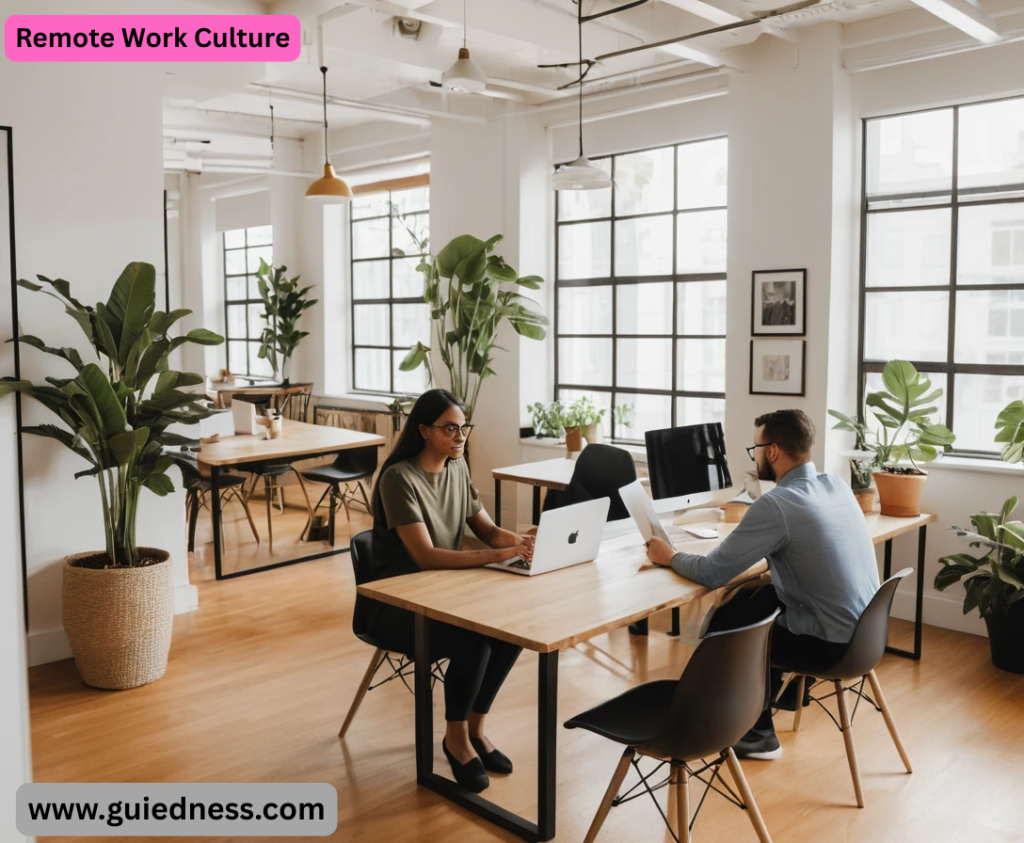

Remote Work Culture Of course. Remote work culture is the set of shared values, practices, and expectations that define how a distributed team operates and collaborates. It’s the virtual equivalent of an office environment, and building it intentionally is critical for success. Here’s a comprehensive breakdown of remote work culture, covering its pillars, benefits, challenges, and how to build and maintain it.
The Pillars of a Strong Remote Work Culture
- A healthy remote culture isn’t automatic; it’s built on these foundational elements:
Trust & Autonomy:
- Core Idea: The culture shifts from “managing time” (clock-watching) to “managing outcomes” (results-oriented).
- In Practice: Employees are trusted to do their best work without constant supervision. Micromanagement is the enemy of remote culture.
Communication & Collaboration:
- Core Idea: Communication must be intentional, clear, and often asynchronous.
- In Practice: Using the right tools for the right purpose (e.g., Slack for quick questions, email for formal communication, Loom for video updates). Over-communication is encouraged to combat ambiguity.
Connection & Belonging:
- Core Idea: Fostering genuine human relationships beyond work tasks.
- In Practice: Creating virtual spaces for social interaction (e.g., #random channels, virtual coffee chats, online games) and making time for non-work-related conversation.
Flexibility & Inclusivity:
- Core Idea: Acknowledging that employees have lives outside of work and allowing them to work in a way that suits them best.
- In Practice: Flexible hours, focus on output over hours logged, and ensuring all team members, regardless of location or time zone, have an equal voice and access to information.
Clear Goals & Accountability:
- Core Idea: Everyone understands the company and team objectives and how their work contributes to them.
- In Practice: Using frameworks like OKRs (Objectives and Key Results), holding regular check-ins, and ensuring transparency on progress and roadblocks.
Benefits of a Strong Remote Culture
- Increased Productivity & Focus: Fewer office distractions allow for deep work.
- Access to a Global Talent Pool: Hire the best people, not just the best people within a commuting radius.
- Enhanced Employee Well-being & Satisfaction: Reduced commute stress and better work-life integration lead to happier employees.
- Higher Retention: Employees who feel trusted and valued are less likely to leave.
- Reduced Overhead Costs: Less money spent on physical office space, utilities, and supplies.
Common Challenges & Pitfalls
- Proximity Bias: The unconscious tendency for managers to favor employees who are physically closer to them (or more visible online). This can disadvantage silent contributors and those in different time zones.
- Burnout & The “Always-On” Mentality: The line between work and home blurs, making it hard to “switch off.”
- Isolation & Loneliness: Lack of casual social interaction can impact mental health and team cohesion.
- Communication Silos & Misunderstandings: Without body language and tone, written messages can be misinterpreted. Information can get stuck in private messages.
- Onboarding & Integrating New Hires: It’s harder to absorb company culture and build relationships when you’re not physically present.
Leadership & Strategy:
- Define and Document Your Values: What does your company truly stand for? Document these principles and reference them in decision-making.
- Lead by Example: Leaders must model healthy behavior—taking time off, setting communication boundaries, and being transparent.
- Invest in the Right Tools: Provide a robust tech stack (e.g., Slack, Teams, Zoom, Asana, Notion, Loom) and train people on how to use them effectively.
Communication:
- Default to Asynchronous: Create a culture where not everything requires an immediate response. This empowers deep work and supports different time zones.
- Establish Communication Norms: Create team agreements on response time expectations, which tool to use for what, and video call etiquette.
- Document Everything: Use a central wiki (like Notion or Confluence) to document processes, decisions, and projects. This creates a single source of truth.
Connection & Community:
Create Intentional Social Spaces:
- Virtual Coffee/Lunch Buddies: Use tools like Donut (a Slack integration) to randomly pair teammates for casual chats.
- Dedicated Non-Work Channels: Have channels for pets, hobbies, gaming, or book clubs.
- Virtual Events: Host regular fun events like trivia, cooking classes, or online game nights.
Make Meetings Meaningful:
- Start team meetings with an icebreaker or personal check-in.
- Have a “no agenda, no meeting” rule to respect everyone’s time.
For Management & Operations:
- Focus on Outcomes, Not Activity: Measure success by what is delivered, not by hours spent online.
- Regular 1-on-1s: These are crucial for understanding career goals, providing feedback, and addressing any concerns privately.
Promote Wellness & Boundaries:
- Encourage employees to use their vacation time.
- Discourage after-hours communication.
- Offer wellness stipends for home office equipment, gym memberships, or therapy.
Advanced Strategies & Nuanced Practices
Mastering Asynchronous Communication (Async)
- Async is the true superpower of remote work, but it requires discipline.
- The “Async-First” Mindset: Assume people won’t be available at the same time. This forces better documentation and clearer thinking.
- Practice: Instead of a quick Zoom call to solve a problem, write a detailed post in a tool like Threads, Slack (in a channel), or Loom. This creates a searchable record and allows people in different time zones to contribute.
- Writing with Context: A good async update is self-contained.
- Use Templates: Create templates for common updates (e.g., Project Kick-off, Weekly Check-in, Post-Mortem) that prompt for Background, Goal, Key Information, and Action Items.
- The 5Ws: Ensure your messages answer: Who is this for? What is it? When is it needed? Why is it important? Where can I find more info?
Combatting Proximity Bias Systematically
This is one of the hardest cultural challenges to overcome.
- Structured Meeting Facilitation: The loudest voices shouldn’t win.
- Tactics: Use a “round-robin” style where everyone speaks at the start of a meeting. Designate a “devil’s advocate” to challenge groupthink. Use collaborative documents (like Google Docs) for real-time, silent brainstorming where everyone can contribute equally.
- “Read the Room” Reports: For managers, assign a team member to be a “Vibe Check” lead in meetings. Their job is to notice who hasn’t spoken and invite them to contribute.
- Public Recognition: Celebrate wins and contributions in public channels, explicitly calling out the work of quieter or more junior team members. This makes their impact visible.

Intentional Onboarding & Knowledge Management
In an office, culture is “caught.” Remotely, it must be “taught.”
- The Onboarding “Buddy” System: Pair a new hire with a peer (not their manager) for the first month. The buddy is their go-to for “stupid questions” and cultural norms.
- Create a “Culture Code” Deck: A living document that goes beyond the corporate values statement. It should include:
- “How We Work”: Our communication norms, meeting philosophies, and decision-making frameworks (e.g., RACI, DACI).
- “Our Lexicon”: Internal acronyms and slang.
- “Meet the People”: Fun, personal profiles of team members.
- Documenting “Tacit Knowledge”: Create a process for capturing the “why” behind decisions. After a project concludes, a “Lessons Learned” document should be added to the central wiki.
Rethinking Performance & Career Growth
How do you measure performance and promote people when you can’t see them?
- Focus on “Impact Narratives”: During performance reviews, employees should write a narrative documenting their achievements, linking them directly to company goals, using data and artifacts (e.g., “I built X, which resulted in a 15% increase in Y, as shown in this dashboard”).
- Transparent Career Ladders: Make career progression paths publicly available, with clear, objective criteria for each level (e.g., “A Senior Engineer autonomously leads projects impacting multiple teams”).
- “Project-Based” Growth: Give employees opportunities to lead or contribute to cross-functional projects outside their usual domain to demonstrate and develop new skills.
The Evolution: Hybrid Culture – The Hardest Model of All
- Many companies are adopting hybrid models, which present a unique set of cultural challenges.
- The Danger of a “Two-Tier” System: Office-based employees become the “in-group,” and remote employees the “out-group.”
Solving the “Room vs. Zoom” Problem:
- Rule: “If one person is remote, everyone is remote.” Even if five people are in the office, they should join the meeting from their individual laptops in separate spaces (or a dedicated meeting room with a single, high-quality camera/mic) to create a level playing field.
- Intentional Office Use: Redefine the purpose of the physical office. It should be for collaboration, connection, and mentorship, not for solo work. This makes coming in worthwhile.
The Future of Remote Work Culture
- AI Integration: AI will summarize long async threads, transcribe and highlight key meeting points, and even suggest potential connections between team members based on projects.
- Focus on “Deep Work” & “Flow Time”: Companies will become more sophisticated about protecting employees’ focus. This could mean formalized “no meeting” blocks or tools that automatically sync “focus mode” across calendars.
- The “Digital Headquarters”: The company’s primary identity will exist in the digital realm, with the physical office becoming an optional accessory—a “clubhouse” rather than the “headquarters.”
- Outcome-Based Economics: Compensation may increasingly be tied to deliverables and impact rather than location or seniority, fully decoupling pay from physical presence.
- Manager Training Revolution: The skills needed to manage a remote team are fundamentally different. Training will shift from surveillance tactics to coaching for outcomes, fostering connection, and building psychological safety from a distance.