

Reliability and Dependability Of course. This is an excellent and fundamental topic in engineering, systems theory, and risk management. While often used interchangeably in everyday language, “Reliability” and “Dependability” have distinct and nuanced meanings in a technical context. Here’s a detailed breakdown.

The Core Analogy: A Car
- Reliability: Is the car likely to start every morning and get you to work without breaking down? It’s about not failing.
- Dependability: Can you depend on the car for your daily commute, considering that sometimes you might have a flat tire (which is a failure), but the run-flat tires allow you to safely get to a garage? It’s about being fit for purpose, even when things go wrong.
Reliability
- Reliability is about consistent performance over time under stated conditions. It answers the question: “Will it work correctly when I need it to?”
Key Focus: Avoiding Failures
Core Metric:
- MTBF (Mean Time Between Failures): The average time a system operates before it fails. A higher MTBF means higher reliability.
- Failure Rate (λ): The frequency with which a component or system fails.
- Definition: The probability that a system, component, or device will perform its intended function without failure for a specified period under stated operating conditions.
Key Aspects:
- Time-Oriented: Reliability is always measured over a period (e.g., 10,000 hours).
- Condition-Specific: It’s defined for specific operating conditions (e.g., temperature, humidity, load).
- Focus on “Correct Service”: It’s concerned with the system working as specified.
Example:
- A specific model of a hard drive has an MTBF of 1.2 million hours. This is a measure of its reliability—it tells you how long you can expect it to run without a mechanical failure under normal conditions.
Dependability
- Dependability is a broader, more encompassing concept. It is the ability to deliver service that can justifiably be trusted. It answers the question: “Can I count on it overall, even when things go wrong?”
Key Focus: Delivering Trustworthy Service
- Core Components: Dependability is not a single metric but a composite concept built on several attributes, including:
- Availability: The readiness for correct service.
- Metric: Uptime / (Uptime + Downtime). Often expressed as “five nines” (99.999% available).
- Reliability: (As defined above) Continuity of correct service.
- Safety: The absence of catastrophic consequences on the user(s) and the environment. A system can be “safe” even if it fails (e.g., it shuts down instead of exploding).
- Integrity: The absence of improper system alterations (i.e., protection against data corruption or unauthorized changes).
- Maintainability: The ability to undergo modifications and repairs easily and quickly. This directly impacts availability.
- Confidentiality: The absence of unauthorized disclosure of information.

Means to Achieve Dependability:
These are the methods used to build a dependable system:
- Fault Prevention: Preventing the occurrence or introduction of faults (e.g., rigorous design standards).
- Fault Tolerance: Building a system that can continue correct operation even in the presence of internal faults (e.g., redundancy, backup systems).
- Fault Removal: Reducing the number or severity of faults (e.g., testing and debugging).
- Fault Forecasting: Estimating the present number, future incidence, and likely consequences of faults (e.g., risk analysis, reliability modeling).
Practical Example: A Cloud Storage Service (e.g., Google Drive, Dropbox)
- Reliability: The probability that the service will not experience a total outage over a year. It’s about the servers staying up.
- Dependability: This is the overall trust you place in the service. It includes:
- Availability: The service is up and accessible when you need it (e.g., 99.9% uptime).
- Reliability: The underlying infrastructure doesn’t crash frequently.
- Integrity: Your files are not corrupted when you save or retrieve them.
- Confidentiality: Your files are encrypted and protected from unauthorized access.
- Maintainability: The provider can apply security patches and upgrades with minimal disruption (improving availability).
- You can have a reliable service (the servers rarely crash) that is not dependable if it has poor security (low confidentiality) and frequently corrupts data (low integrity).
Industry-Specific Perspectives
Aerospace & Aviation
- Reliability and Dependability Reliability: Probability an aircraft completes a mission without failure
- Dependability: Includes ability to operate in diverse conditions, maintain flight safety during failures, and meet scheduling requirements
- Standards: DO-178C (software), DO-254 (hardware)
Medical Devices
- Reliability: Device performs intended function without failure over its lifespan
- Dependability: Includes safety (no harm to patient), data integrity, and availability during critical procedures
- Regulations: FDA 21 CFR Part 820, ISO 13485
Automotive
- Reliability: Component lifespan (e.g., engine runs 200,000 miles)
- Dependability: Overall vehicle trustworthiness including safety systems, repair costs, and performance in various conditions
- Standards: ISO 26262 (functional safety)
Cloud Computing & IT
Indicators (SLIs)
- Availability = Uptime / (Uptime + Downtime)
- Error Rate = Failed Requests / Total Requests
- Throughput = Requests per second
- Latency = Time to complete requests
Objectives (SLOs)
- “Availability ≥ 99.9% over 30-day period”
- “95% of requests < 100ms latency”
Agreements (SLAs)
- Contractual obligations with penalties
Design Methodologies
For High Reliability
- Derating: Operating components below rated specifications
Redundancy:
- Active: All components operational
- Passive: Backup components take over during failure
N+1, 2N, 2N+1 configurations
- Robust Design: Taguchi methods, tolerance analysis
- Failure Mode and Effects Analysis (FMEA)
- Reliability-Centered Maintenance (RCM)
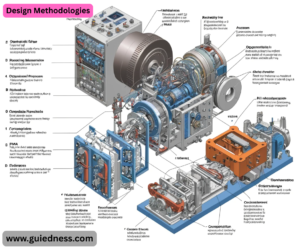
For High Dependability
Fault Tolerance Architectures:
- Triple Modular Redundancy (TMR)
- RAID storage systems
- Hot-swappable components
- Formal Methods: Mathematical verification of critical systems
- Defense in Depth: Multiple layers of security and protection
- Graceful Degradation: System maintains limited functionality during failures
Example 2: Automotive Braking System
- Reliability Requirement: Probability of failure < 10⁻⁹ per hour
- Safety Requirement: No single point of failure can cause total brake loss
- Dependability Implementation: Dual hydraulic circuits, electronic brake force distribution, ABS redundancy
Emerging Challenges
Cyber-Physical Systems
- Integration of computational and physical processes
- Requires co-design of reliability and security
- Example: Autonomous vehicles must be reliable (don’t break down) and dependable (safe, secure, available)
Internet of Things (IoT)
- Massive scale creates reliability challenges
- Dependability must consider energy constraints, connectivity issues, and security threats
- Trade-offs between performance and reliability
Artificial Intelligence Systems
- Reliability and Dependability Reliability: Consistent performance across diverse inputs
- Dependability: Includes explainability, fairness, robustness to adversarial attacks
- New metrics: Model drift detection, fairness indices
Standards and Frameworks
International Standards
- IEC 61508: Functional safety of electrical/electronic/programmable electronic systems
- ISO 9001: Quality management systems
- ISO/IEC 25010: Systems and software quality requirements
- NIST SP 800-53: Security and privacy controls
Industry Best Practices
- ITIL: IT service management
- COBIT: Governance and management of enterprise IT
- Site Reliability Engineering (SRE): Google’s approach to service management
The Human Factor
Human Reliability Analysis (HRA)
- Techniques: THERP, HEART, CREAM
- Considers human error probabilities in system dependability
- Critical in aviation, nuclear, and medical domains
Organizational Dependability
- Safety culture and reporting systems
- Continuous improvement processes
- Learning from incidents and near-misses