

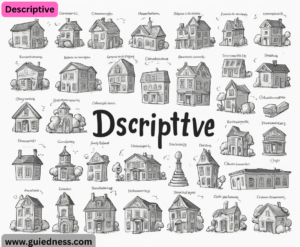
Descriptive Of course! “Descriptive” is a powerful and versatile word. At its core, it means serving to describe or characterize something. Let’s break down what that truly means, how it’s used, and why it’s so important.
The Core Meaning
- When something is descriptive, it provides details, qualities, and features that paint a vivid picture in the mind of the reader or listener. It goes beyond a simple label and answers questions like:
- What does it look, sound, smell, taste, or feel like?
- What is its nature or essence?
- What are its key characteristics?
- In Different Contexts
- The word “descriptive” is used in several key areas:
Language and Writing
- This is the most common usage. Descriptive language (or imagery) uses sensory details to create a vivid experience.
- Simple: “The food was good.”
- Descriptive: “The rich, aromatic stew bubbled in the pot, its savory scent of thyme and slow-cooked beef filling the entire kitchen.”
- Literary Device: Descriptive writing is a mode of writing where the author’s primary purpose is to describe a person, place, thing, or event so that the subject becomes alive for the reader.
Science and Research
- Here, “descriptive” refers to a method of study that observes and records behavior or phenomena without influencing it.
- Descriptive Statistics: These summarize and describe the features of a data set (e.g., the average height of a class, the percentage of people who prefer cats over dogs).
- Descriptive Research: A type of research that describes the current state of affairs, like taking a snapshot of a population (e.g., a census or a survey about consumer habits).
Linguistics
- A descriptive approach to language analyzes and documents how a language is actually used by its speakers, without making judgments about what is “correct” or “incorrect.” This contrasts with a prescriptive approach, which dictates rules for how a language should be used.
- Descriptive Linguist: “Many people use ‘they’ as a singular pronoun. This is a natural evolution of the language.”
Key Characteristics of Effective Description
Good description isn’t just about piling on adjectives. It’s about:
- Appealing to the Senses: Sight, sound, smell, touch, and taste.
- Using Figurative Language: Metaphors, similes, and personification (“The wind whispered through the trees”).
- Being Specific and Precise: “A 1967 Ford Mustang” instead of “an old car.”
- Creating a Mood or Atmosphere: Descriptive words can make a scene feel eerie, joyful, tranquil, or tense.
Examples in Sentences
- “The author’s descriptive prose made me feel like I was actually walking through the misty Scottish Highlands.”
- “Please write a descriptive paragraph about your favorite childhood memory.”
- “The geologist gave a highly descriptive account of the volcanic rock formation.”
- “He’s a very descriptive storyteller; he remembers every little detail.”
Levels of Description: From Basic to Vivid
Think of description on a spectrum:
- Labeling (Non-Descriptive): “A tree.”
- Basic Description: “A tall tree with green leaves.”
- Vivid, Sensory Description: “The ancient oak towered over the field, its gnarled branches casting a lacework of shadows on the grass below. A breeze rustled through its countless leaves, creating a sound like gentle applause.”
- The goal of powerful descriptive writing is to bridge the gap between #2 and #3.

The “How-To”: Building a Descriptive Toolkit
To be effectively descriptive, you need a toolbox of techniques:
The Five Senses (Plus One):
- Sight (Visual): The most common. Use color, shape, size, light, and shadow.
- Example: “The crimson sunset bled into the purple-hazed mountains.”
- Sound (Auditory): Creates atmosphere.
- Example: “The distant, rhythmic crash of waves contrasted with the sharp, frantic chirping of crickets.”
- Smell (Olfactory): Deeply connected to memory and emotion.
- Example: “The room held the faint, sweet scent of dried roses and dust.”
- Touch (Tactile): Evokes physical sensation.
- Example: “She ran her hand over the weather-beaten, splintery wood of the fence.”
- Taste (Gustatory): Can be literal or metaphorical.
- The “Plus One” – Kinaesthesia (Sense of Movement): Describing bodily movement or pressure.
- Example: “He felt the dull, throbbing ache in his muscles after the long climb.”
Figurative Language:
- Simile: A comparison using “like” or “as.”
- Example: “The city lights at night sprawled like a carelessly thrown handful of jewels.”
- Metaphor: A direct comparison stating that something is something else.
- Example: “The road was a black ribbon unfurling through the desert.”
- Personification: Giving human traits to non-human things.
Specificity & Word Choice (Diction):
- Vague: “He moved the thing.”
- Descriptive: “He heaved the rust-streaked anvil.”
- Use strong, precise verbs and nouns. Instead of “walked,” consider trudged, shuffled, strutted, stalked.
Advanced Concepts: The Power and Pitfalls of Description
The Psychology of Description:
- Description isn’t just about providing information; it’s about controlling attention and evoking emotion. By choosing what to describe and how, the writer guides the reader’s feelings. Describing a character’s chipped nail polish and frayed cuff can say more about their economic state than simply stating “he was poor.”
The “Iceberg Theory” (Ernest Hemingway):
- This is the opposite of overt description, but it’s a descriptive technique in its own right. Hemingway believed writers should present the surface details (the “tip of the iceberg”) and let the deeper meaning remain unstated, but implied. The description is sparse but carefully chosen to hint at the submerged emotions.
- Example: Instead of describing a couple’s sadness in detail, you might write: “They sat at the table. The coffee was cold. The rain tapped against the window.” The description of the cold coffee and rain implies the emotional state.
Pitfalls to Avoid:
- The “Purple Prose” Trap: Overloading sentences with too many adjectives and adverbs, making them sound flowery and artificial. (“The magnificent, glorious, radiantly effulgent sun rose over the sparkling, azure, gently undulating sea.”)
- Stopping the Action: Pausing a fast-paced action scene for three paragraphs to describe a castle wall.
- Irrelevant Detail: Describing everything just because you can. Every description should serve a purpose—to set a mood, develop character, or advance the theme.
The Philosophy of Description: A Deeper Layer
- At its most fundamental, description is an act of interpretation, not just observation. When we describe, we are not simply mirroring reality; we are filtering it through our own consciousness, biases, and language.
- The Map is Not the Territory: This phrase from Alfred Korzybski highlights that a description (the map) is never the actual thing itself (the territory). Your description of a “cozy, charming cottage” might be another person’s “cramped, old shack.” Description is inherently subjective.
- Phenomenology: This philosophical school focuses on the structures of experience and consciousness. A phenomenological description would try to capture the “lived experience” of something—not just the red of an apple, but the feeling of seeing that red, the memories it might evoke.
- This means that what you choose not to describe is as powerful as what you choose to include. Every description is an argument for a certain way of seeing the world.