
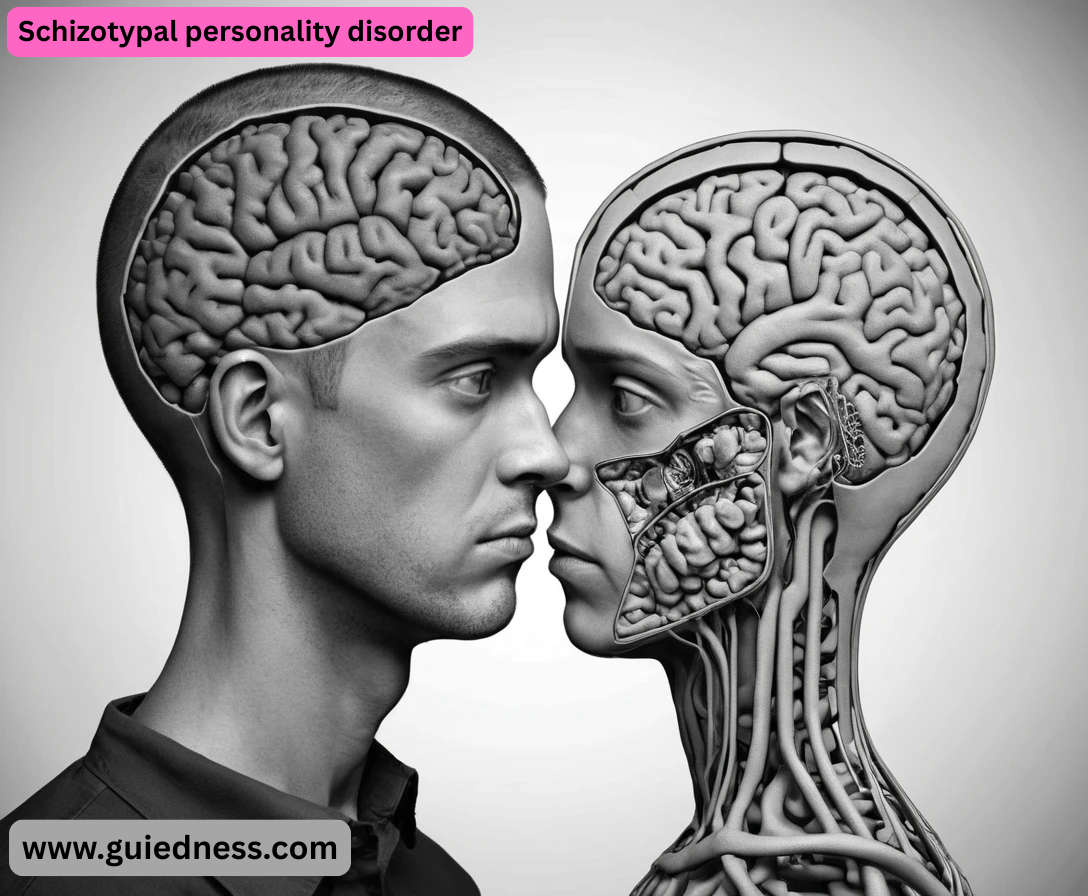
Schizotypal personality disorder Schizotypal Personality Disorder (STPD) is a chronic mental health condition characterized by a pervasive pattern of intense discomfort with close relationships, social and interpersonal deficits, and cognitive or perceptual distortions, along with eccentricities of behavior. People with STPD often appear “odd” or “peculiar” to others. They typically have a limited capacity for close relationships and hold ideas that are not based in reality, though they do not typically experience the full-blown psychosis (like hallucinations or delusions) seen in schizophrenia.

Key Symptoms and Characteristics
- The symptoms of STPD, as outlined in the DSM-5 (Diagnostic and Statistical Manual of Mental Disorders, Fifth Edition), are a mix of social, cognitive, and behavioral eccentricities. To be diagnosed, an individual must exhibit a persistent pattern of at least five of the following:
- Ideas of Reference: Believing that casual incidents, external events, or the behavior of others have a particular and unusual meaning specifically for them (e.g., believing a TV news anchor is sending them a secret message).
- Odd Beliefs or Magical Thinking: Holding beliefs that are outside the norms of their subculture (e.g., believing in clairvoyance, telepathy, or a “sixth sense”). They may feel they have special, magical control over others.
- Unusual Perceptual Experiences: These can include bodily illusions or sensing a “presence” that isn’t there. While they may not have full auditory or visual hallucinations, their perceptions are often distorted.
- Odd Thinking and Speech: Speech may be vague, metaphorical, overly elaborate, or stereotyped. It can be strange in flow or content but not to the point of incoherence.
- Suspiciousness or Paranoid Ideation: They are often suspicious of others and may believe others are out to harm or deceive them, without sufficient evidence.
- Inappropriate or Constricted Affect: Their emotional responses may be blunted, flat, or inappropriate to the situation. They may appear cold or aloof.
- Behavior or Appearance that is Odd, Eccentric, or Peculiar: They may dress in an unkempt, unusual manner or have odd mannerisms (e.g., avoiding eye contact, talking to themselves).
- Lack of Close Friends: Beyond first-degree relatives, they have no or very few close friends or confidants.
- Excessive Social Anxiety that does not diminish with familiarity and is tied to paranoid fears rather than negative judgments about self.
STPD vs. Other Disorders: The “Schizophrenia Spectrum”
STPD exists on a spectrum with schizophrenia. It’s important to distinguish it from related disorders:
- vs. Schizophrenia: The key difference is that individuals with STPD do not experience persistent psychosis. Their odd beliefs are “ideas,” not fixed delusions, and their perceptual experiences are illusions, not clear hallucinations. They generally remain in touch with reality, though their interpretation of it is distorted.
- vs. Schizoid Personality Disorder: Both involve social detachment. However, people with Schizoid PD are simply indifferent to social relationships and prefer being alone. People with STPD desire relationships but are prevented by intense anxiety, paranoia, and eccentricity.
- vs. Paranoid Personality Disorder: Both involve distrust and suspicion. However, Paranoid PD is dominated by this suspicion without the eccentric thinking, magical beliefs, and odd behavior central to STPD.
- vs. Autism Spectrum Disorder (ASD): There can be overlapping social difficulties, but ASD is characterized by restricted, repetitive patterns of behavior and interests, and deficits in social-emotional reciprocity from early development. STPD’s social deficits are more rooted in paranoia and cognitive distortions.
Causes and Risk Factors
The exact cause is unknown, but it’s likely a combination of factors:
- Genetics: STPD is more common in biological relatives of individuals with schizophrenia, suggesting a strong genetic link.
- Brain Function: Neuroimaging studies suggest there may be differences in the brain pathways that manage dopamine and brain structure (e.g., slight reductions in temporal lobe volume).
- Environment: Childhood trauma, neglect, or high stress may trigger the disorder in those genetically predisposed. A history of social ostracism or having a highly critical parent may also be contributing factors.
Diagnosis and Treatment
- Diagnosis: There is no lab test for STPD. A diagnosis is made by a mental health professional (like a psychiatrist or psychologist) through clinical interviews and a thorough assessment of the person’s history and symptoms.
- Treatment can be challenging, as individuals with STPD are often suspicious of others, including therapists. However, it can be effective:
- Psychotherapy (Talk Therapy): This is the primary treatment.
- Cognitive-Behavioral Therapy(CBT): Helps identify and challenge distorted thought patterns and manage social anxiety.
- Supportive Therapy: Provides a safe, non-judgmental environment to build trust and improve social skills and coping mechanisms.
- Social Skills Training: Can help the person learn how to interact more appropriately with others.
- Medication: There are no medications specifically approved for STPD, but doctors may prescribe certain drugs “off-label” to target specific symptoms.
- Antipsychotics: Low doses can help reduce odd thinking, paranoia, and anxiety.
- Antidepressants (SSRIs): Can be useful for co-occurring depression or anxiety.
The Lived Experience: What It Feels Like From the Inside
- Imagine constantly feeling like an outsider, as if everyone else has a rulebook for social interaction that you never received. Your internal world is populated by strange connections and meanings that others dismiss.
- The Social World is a Minefield: Small talk isn’t just boring; it’s terrifyingly opaque. You might spend hours analyzing a simple “hello,” convinced it held a hidden, threatening meaning. This leads to excessive social anxiety that doesn’t go away because it’s rooted in paranoia (fear of others’ intentions) rather than simple shyness or low self-esteem.
- A Magical Universe: The world isn’t just a mechanical place. You might genuinely believe that by thinking a certain thought, you can prevent a bad event, or that the pattern of clouds is a specific sign for you. This magical thinking provides a sense of control and meaning in a confusing world.
- Reality is “Soft”: Your perceptions can’t always be trusted. You might see shadows move in the corner of your eye or hear your name whispered when no one is there. These illusory experiences stop short of full hallucinations but contribute to a sense that reality is not solid or reliable.
- The Pain of Loneliness vs. the Fear of Connection: Unlike someone with Schizoid PD, a person with STPD often desperately wants friends and intimacy. However, their intense fear, mistrust, and eccentric behavior create a barrier. This leads to a profound and chronic loneliness, often described as the core wound of the disorder.
Subtypes of Schizotypal Personality Disorder
Theodore Millon, a prominent personality theorist, proposed four subtypes of STPD, which help illustrate the diversity of its presentation:
- The Insipid Schizotypal: Characterized by a gradual onset of fundamental deficits. They appear bland, dull, and emotionally vacant, with a chronic sense of emptiness and joylessness. This is the “deficit” subtype.
- The Timorous Schizotypal: Defined by persistent anxiety, fearfulness, and a sense of being powerless. They are dogged by suspiciousness and a “beleaguered” state, constantly expecting to be hurt or humiliated. Social anxiety is their dominant feature.
- The Disorganized Schizotypal: Shows more pronounced cognitive slippage and fragmented thinking. Their speech may be more tangential and peculiar. They appear more overtly confused and eccentric, bordering on the disorganization seen in schizophrenia.
- The Borderline Schizotypal: An unstable mix of STPD and Borderline Personality Disorder features. They may experience micro-psychotic episodes under stress, have intense, chaotic relationships, and display identity confusion alongside their magical thinking and perceptual distortions.
Deeper Dive into Key Concepts
Ideas of Reference vs. Delusions of Reference:
This is a critical distinction.
- Schizotypal personality disorder Idea of Reference: The person interprets a neutral event as being personally meaningful. They might see two people laughing and feel a nagging suspicion that they are the butt of the joke. If presented with an alternative explanation (“They were laughing at a video”), they can, at least momentarily, entertain the possibility that they were wrong. It’s a subjectively held belief.
- Delusion of Reference: This is a fixed, false belief. The person is convinced that the people are laughing at them. No evidence or logical argument can shake this conviction. It is an objectively false reality for them. STPD involves the former, while schizophrenia involves the latter.

The Psychosis Bridge:
- STPD is a key disorder on the schizophrenia spectrum. People with STPD are at a significantly higher risk of developing schizophrenia or another psychotic disorder later in life, especially under extreme stress. Their “odd beliefs” and “perceptual experiences” are considered positive symptoms (adding something to normal experience) but at a sub-psychotic level.
Comorbidity (Co-occurring Disorders):
It’s rare for STPD to exist in a vacuum. It frequently co-occurs with:
- Major Depressive Disorder: The chronic loneliness and social failure often lead to profound depression.
- Other Personality Disorders: Especially Paranoid, Schizoid, and Avoidant Personality Disorders.
- Anxiety Disorders: Particularly Social Anxiety Disorder and Generalized Anxiety Disorder.
- Substance Use Disorders: Some may use alcohol or drugs in an attempt to self-medicate their social anxiety or dull their perceptual distortions.
Challenges in Treatment and Management (Beyond the Basics)
- Building Therapeutic Alliance: This is the single biggest challenge. The therapist’s office is a social situation, and the patient’s suspiciousness and paranoia will be directed at the therapist. The therapist must be incredibly patient, consistent, and transparent to build a fragile trust that can take years.
- The Limits of Insight: While people with STPD have more insight than those with psychosis, they may not see their magical beliefs as “symptoms.” Challenging them directly can feel like a personal attack. Effective therapy often focuses on the consequences of the beliefs (“Does believing that make you feel more anxious?”) rather than their truth value.
- Focus on Functioning, Not “Curing”: The goal of treatment is rarely to make the person “normal.” It is to reduce distress, improve social and occupational functioning, and prevent further isolation or the onset of full psychosis. Small gains, like being able to go to a grocery store without overwhelming anxiety, are major victories.