
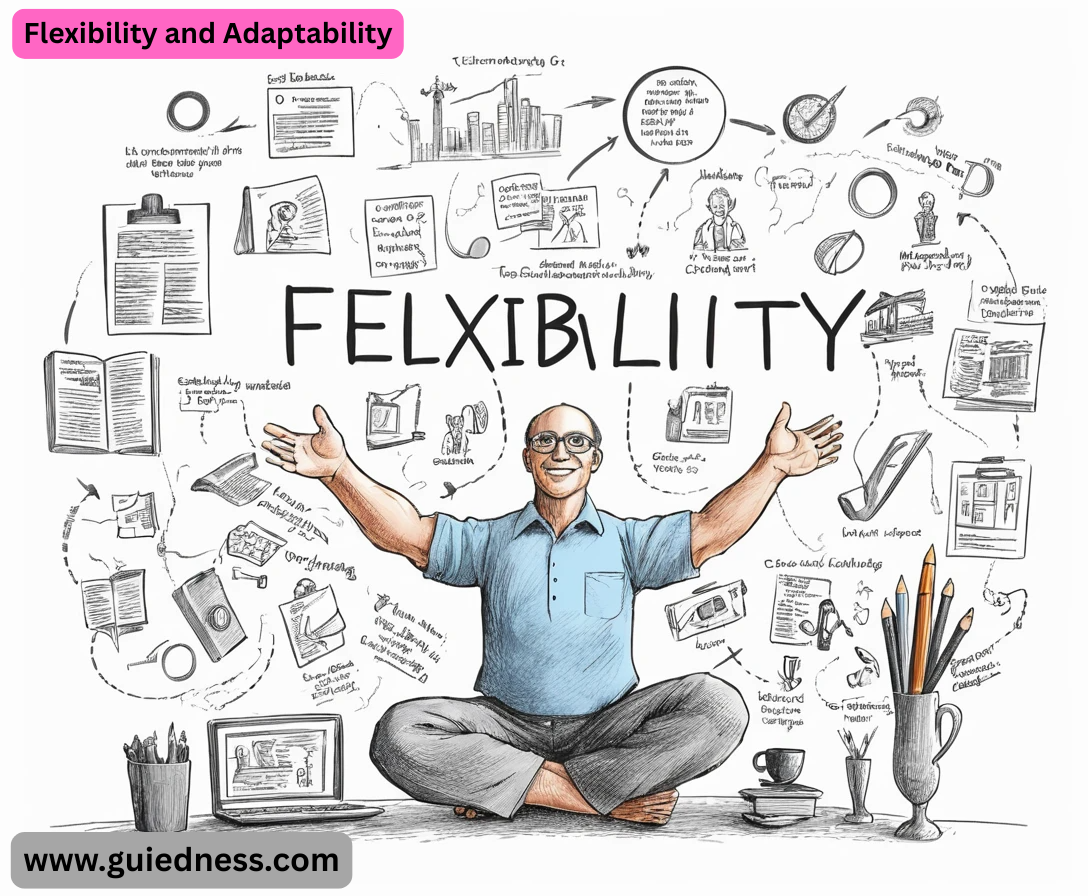
Flexibility and Adaptability Of course. “Flexibility and Adaptability” are two of the most critical skills for thriving in the modern world, both personally and professionally. While often used interchangeably, they have distinct and complementary meanings.
The Core Definitions
- Flexibility is the willingness and ability to change. It’s about being open-minded, pliable, and responsive to new information or slight shifts in direction. Think of it as your mindset.
- Analogy: A bamboo tree bending in the wind. It doesn’t break because it’s flexible.
- Adaptability is the capacity to adjust successfully to new or changing conditions. It’s about learning, problem-solving, and evolving to fit a new environment. Think of it as your skill set and process.
- Analogy: An animal evolving over generations to survive in a new climate. It changes to fit its environment.
- In short: Flexibility is your willingness to bend; Adaptability is your ability to grow and thrive once you’ve bent.
Why They Are So Important Today
- The pace of change in technology, society, and the global economy is unprecedented. Here’s why these traits are no longer just “nice to have” but essential:
In the Workplace:
- Technological Disruption: AI, automation, and new software are constantly reshaping jobs. Adaptable employees learn new tools, while flexible ones are open to the changes they bring.
- Agile Methodologies: Modern projects require iterative processes, shifting priorities, and cross-functional collaboration. Rigidity is the enemy of agility.
- Career Longevity: The “job for life” is gone. The average person will change careers multiple times, requiring constant learning and adaptation.
In Personal Life:
- Navigating Uncertainty: Life is full of unexpected events—a global pandemic, personal loss, or a sudden move. These skills are crucial for mental resilience and bouncing back from adversity.
- Building Strong Relationships: Flexibility allows you to see other perspectives and compromise, which is the foundation of healthy relationships with partners, family, and friends.
- Lifelong Learning: An adaptable mind stays curious and open to new hobbies, skills, and knowledge, leading to a more fulfilling life.
How to Cultivate Flexibility and Adaptability
- These are not just innate traits; they are muscles you can strengthen.
To Become More Flexible:
- Challenge Your Routines: Take a different route to work. Rearrange your desk. Small changes break the grip of rigidity.
- Practice “Yes, And…”: Borrowed from improv comedy, this principle means accepting an idea and building on it instead of shutting it down with a “Yes, but…”
- Seek Diverse Perspectives: Actively listen to people you disagree with. Read books from different genres. This expands your mental models.
- Let Go of Perfectionism: Embrace “good enough” and iterate. Perfectionism is often a fear of change in disguise.

To Become More Adaptable:
- Become a Lifelong Learner: Dedicate time to learning a new skill, whether it’s a language, coding, or playing an instrument. This builds your “adaptation muscle.”
- Step Outside Your Comfort Zone Regularly: Volunteer for a challenging project at work. Travel to a new place. Public speaking. Growth happens at the edge of your comfort zone.
- Develop a Growth Mindset: Believe that your abilities can be developed through dedication and hard work (Carol Dweck’s concept). See challenges as opportunities to learn, not as threats.
- Practice Problem-Solving: When faced with an obstacle, brainstorm multiple solutions instead of fixating on one. This trains your brain to be resourceful.
- Build a Resilient Network: Surround yourself with supportive and diverse people who can offer different perspectives and help when you need to adapt.
The Psychological Underpinnings: Why Change is Hard
- To truly master flexibility and adaptability, it helps to understand the brain’s resistance:
- Cognitive Rigidity: Our brains are prediction engines. They create mental models and shortcuts (heuristics) to conserve energy. Change forces the brain to expend more energy, which it naturally resists.
- The Status Quo Bias: We prefer things to stay the same because the known feels safer than the unknown, even if the known is suboptimal.
- Fear of Failure: Adapting means venturing into the unfamiliar, where the risk of making mistakes is high. This can trigger our ego and sense of competence.
- Flexibility and adaptability are, therefore, a conscious override of these deep-seated psychological tendencies.
Advanced Frameworks and Models
The OODA Loop (Observe, Orient, Decide, Act)
- Developed by military strategist John Boyd, the OODA loop is the ultimate cycle of adaptation.
- Observe: Take in raw information about your changing environment.
- OriENT: This is the crucial, adaptive step. You analyze the information through your existing mental models, cultural traditions, and genetic heritage, and you update your perspective.
- Decide: Formulate a hypothesis or course of action based on your new orientation.
Act: Execute your decision.
- The key is to cycle through this loop faster and more effectively than your challenges (or competitors). A flexible and adaptable person or organization has a very fluid OODA loop.
Carol Dweck’s “Mindset” Theory
This is the foundational mindset for adaptability.
- Fixed Mindset: Believes intelligence and talent are static. Avoids challenges, gives up easily, sees effort as fruitless, and feels threatened by the success of others. (Inflexible and unable to adapt).
- Growth Mindset: Believes abilities can be developed through dedication and hard work.. (The engine of flexibility and adaptability).
Antifragility (Nassim Nicholas Taleb)
- This concept goes beyond resilience and robustness.
- Fragile: Breaks under stress and volatility (e.g., a wine glass).
- Robust: Withstands stress and remains the same (e.g., a rock).
- Resilient: Withstands stress and returns to its original state (e.g., a spring).
- Antifragile: Gets stronger from stress, volatility, and uncertainty (e.g., the human muscular system, which grows stronger when subjected to stress and recovery).
- Cultivating adaptability is the path to becoming antifragile—not just surviving chaos, but thriving because of it.
Real-World Scenarios and Applications
In Leadership and Management:
- Flexible Leader: Is open to feedback, can pivot a meeting’s agenda based on new input, and empowers team members to choose their own methods.
- Adaptable Leader: When a product launch fails, they don’t just blame the team. They analyze the market feedback (Observe), re-evaluate their strategy (Orient), create a new plan (Decide), and execute a pivot (Act). They also invest in upskilling their team for the new direction.

In Personal Relationships:
- Flexible Partner: When their spouse has a bad day, they let go of their planned “date night” and instead offer a quiet evening of support.
- Adaptable Partner: In a long-term relationship, they recognize that the dynamics that worked in their 20s don’t work in their 40s with kids. They communicate to understand the new needs, learn new conflict-resolution skills, and co-create a new, healthier relationship structure.
In Your Career:
- Flexible Employee: Willingly learns to use a new software program the company adopts.
- Adaptable Professional: Sees that AI is automating certain tasks in their field. Instead of resisting, they proactively learn how to use AI tools, positioning themselves as an expert in “AI-augmented” work, thus future-proofing their career.
The Dark Side and Pitfalls
Without balance, these strengths can become weaknesses:
- Extreme Flexibility can become Indecisiveness or a Lack of Conviction: If you’re always bending, you have no core. People may see you as wishy-washy or without a strong vision.
- Constant Adaptation can lead to Burnout: The “adaptation energy” of any system is finite. If the environment is in constant, chaotic flux without periods of stability, the ability to adapt wears thin. This is “change fatigue.”
- Losing Your Core Identity: Adapting your methods is crucial, but you must know what your core values and principles are. Never adapt those away.