
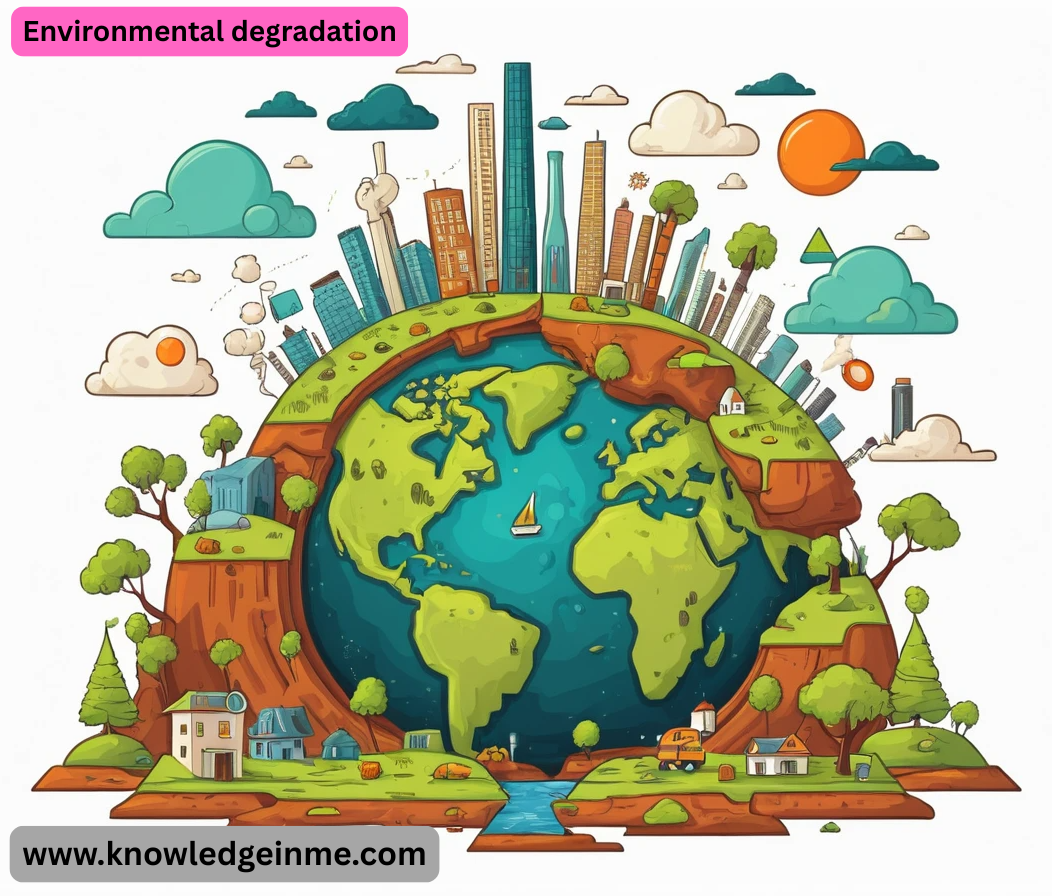
Environmental degradation Of course. Environmental degradation is on e of the most critical and complex challenges facing humanity. Here is a comprehensive overview.
What is Environmental Degradation?
- Essentially, it is the process by which the natural environment is compromised, making it unable to support the species that live in it and disrupting the natural balance of ecosystems.
Primary Causes and Drivers
- Environmental degradation is rarely caused by a single factor. It is typically the result of a complex interplay of human activities and natural processes (though human activity is now the dominant driver).
Human Population Growth:
- More people require more resources (food, water, energy, land), leading to increased pressure on the environment.
Economic Activities:
- Industrialization: Factories release massive amounts of pollutants into the air and water.
- Agriculture: Deforestation for farmland, soil erosion from tilling, and water pollution from pesticides and fertilizers.
- Mining: Destroys landscapes, contaminates soil and water with chemicals, and leads to erosion.
- Overconsumption: The high demand for goods, especially in developed nations, drives resource extraction and waste production.
Urbanization:
- The expansion of cities consumes natural habitats, creates “heat islands,” and generates concentrated waste and pollution.
Pollution:
- Air Pollution: From burning fossil fuels (leading to smog, acid rain, and health problems) and greenhouse gases (causing climate change).
- Water Pollution: From industrial waste, agricultural runoff, sewage, and plastic waste.
Deforestation:
- The clearing of forests for timber, agriculture, or urban development destroys habitats, reduces biodiversity, and disrupts the carbon cycle (trees absorb CO₂).
Climate Change:
- Both a cause and an effect of degradation. Rising global temperatures lead to melting ice caps, sea-level rise, ocean acidification, and more extreme weather events, which further degrade environments.
Key Consequences and Effects
The effects of environmental degradation are far-reaching and often interconnected.
Loss of Biodiversity:
- As ecosystems are degraded, plants and animals cannot survive, leading to a loss of genetic diversity that is crucial for ecosystem resilience.

Public Health Crises:
- Polluted air and water are directly linked to diseases. According to the WHO, air pollution alone causes an estimated 7 million premature deaths annually. Contaminated water leads to cholera, dysentery, and other illnesses.
Ozone Layer Depletion:
- The release of chlorofluorocarbons (CFCs) thinned the protective ozone layer, increasing exposure to harmful UV rays and raising the risk of skin cancer.
Economic Costs:
- Degradation has massive economic impacts: healthcare costs from pollution-related illnesses, loss of productivity from poor health, the cost of cleaning up polluted sites, and the loss of potential revenue from tourism in degraded areas.
Scarcity of Resources:
- Over-exploitation leads to the scarcity of essential resources like fresh water and fertile soil, which can trigger conflicts and create “environmental refugees.”
Impact on Climate Change:
- Deforestation and burning fossil fuels release stored carbon into the atmosphere, accelerating global warming. A warming climate then further degrades environments, creating a vicious feedback loop.
Potential Solutions and Mitigation
Addressing environmental degradation requires a multi-faceted approach at individual, local, national, and global levels.
Policy and Regulation:
- Governments must enact and enforce strong environmental laws (e.g., clean air and water acts, regulations on industrial waste, protections for endangered species and habitats).
- Implementing a “polluter pays” principle to hold companies accountable.
Shift to Sustainable Practices:
- Circular Economy: Designing waste out of the system, keeping products and materials in use for as long as possible through recycling, reuse, and repair.
Conservation and Restoration:
- Protecting existing natural areas through national parks and marine reserves.
- Actively restoring degraded ecosystems (e.g., reforestation, wetland restoration).
Technological Innovation:
- Developing cleaner technologies for industry and transportation.
- Advancing water purification and waste management systems.
- Creating more efficient methods for recycling.
Individual Action and Education:
- Reducing consumption, reusing items, and recycling.
- Conserving water and energy at home.
- Supporting sustainable and ethical companies.
- Raising awareness and advocating for change. An educated public is essential for driving political and corporate action.
International Cooperation:
- Environmental problems like climate change and ocean plastic are global and require global solutions. International agreements like the Paris Agreement (climate change) and the Montreal Protocol (ozone) are crucial frameworks for coordinated action.
The Vicious Cycles and Interconnectedness
A key feature of modern environmental degradation is that problems are rarely isolated. They create vicious, self-reinforcing cycles:
The Climate-Deforestation Feedback Loop:
- Forests are cut down for agriculture or timber.
- Climate change leads to increased droughts and wildfires.
- Droughts and wildfires destroy more forests.
- The loop continues, intensifying with each iteration.

The Albedo Effect (Ice-Loss Feedback Loop):
- Global temperatures rise, causing polar ice and glaciers to melt.
- Ice and snow are highly reflective (high albedo), bouncing solar energy back into space.
- As they melt, they are replaced by dark ocean water or land, which absorb more solar energy.
- This absorption leads to further warming, which leads to more ice melt.
The Agriculture-Soil Degradation Loop:
- Demand for food increases, leading to intensive farming.
- Intensive farming depletes soil nutrients and causes erosion.
- Degraded soil is less fertile and holds less water.
- To maintain yields, farmers use more chemical fertilizers and pesticides, which further degrade soil health and pollute waterways, creating dead zones.
- The need for more farmland leads to further deforestation, restarting the cycle.
Less Visible Forms of Degradation
- Ocean Acidification: Often called “the other carbon problem.” The ocean absorbs about 30% of the CO₂ we release. This reacts with seawater to form carbonic acid, lowering the pH. This acidity makes it difficult for marine organisms like corals, plankton, and shellfish to build their calcium carbonate shells and skeletons, threatening the entire marine food web.
- Light Pollution: The excessive, misdirected, or obtrusive use of artificial light disrupts ecosystems. It confuses migratory birds, disorients baby sea turtles, and impacts the reproductive cycles of nocturnal animals. It also has documented effects on human circadian rhythms.
- Noise Pollution: Underwater noise from shipping, sonar, and construction disrupts marine life that relies on sound for communication, navigation, and finding food. On land, chronic noise pollution from traffic and industry stresses wildlife, altering their behavior and distribution.
- Microplastic Pollution: Plastic waste doesn’t truly disappear; it breaks down into tiny particles smaller than 5mm. These microplastics are now ubiquitous—in our water, soil, air, and food. Their long-term impact on ecosystems and human health is still being studied but is a major concern.
- Nitrogen Pollution: While nitrogen is essential for life, human activity (primarily through synthetic fertilizers) has doubled the amount of reactive nitrogen in the global cycle. This excess runs off into waterways, causing algal blooms that deplete oxygen and create “dead zones” where nothing can live.
The Social and Equity Dimension
Environmental degradation does not affect everyone equally.
- Burden on the Poor: Often, the most polluted areas (landfills, industrial complexes, contaminated sites) are located in or near low-income and marginalized communities.
- Global Inequity: The Global North, which has historically contributed the most to problems like climate change and plastic waste, is often less immediately vulnerable to its worst effects than developing nations in the Global South. These nations face more severe consequences—droughts, floods, sea-level rise—despite having contributed the least to the problem. This raises profound questions of climate justice.
- Indigenous Communities: Indigenous peoples are often the most effective stewards of their ancestral lands. However, their territories are frequently targeted for resource extraction (mining, logging, oil drilling), leading to degradation and the loss of their livelihoods and culture.
Beyond Traditional Solutions: Deeper Shifts
While regulations and clean technology are essential, addressing the root causes requires more fundamental shifts:
- It argues that the goal of economic activity should be to meet the needs of all people (the social foundation) without overshooting the Earth’s ecological ceilings (the environmental ceiling).
- Decoupling: A core goal for sustainable development is to decouple economic growth from environmental degradation. This means finding ways to generate economic value without increasing resource use and pollution. This can be:
- Relative decoupling: Using fewer resources per unit of GDP.
- Absolute decoupling: Reducing total resource use and environmental impact even as the economy grows. This is far more challenging and has rarely been achieved at a global scale.
- Changing Value Systems: Moving from a paradigm of anthropocentrism (human-centered value) to ecocentrism (Earth-centered value). This involves recognizing the intrinsic value of nature, beyond its utility to humans. This shift is cultural and philosophical, influencing law, education, and ethics.
- The Precautionary Principle: This would fundamentally change how we approve new chemicals, technologies, and industrial projects.