
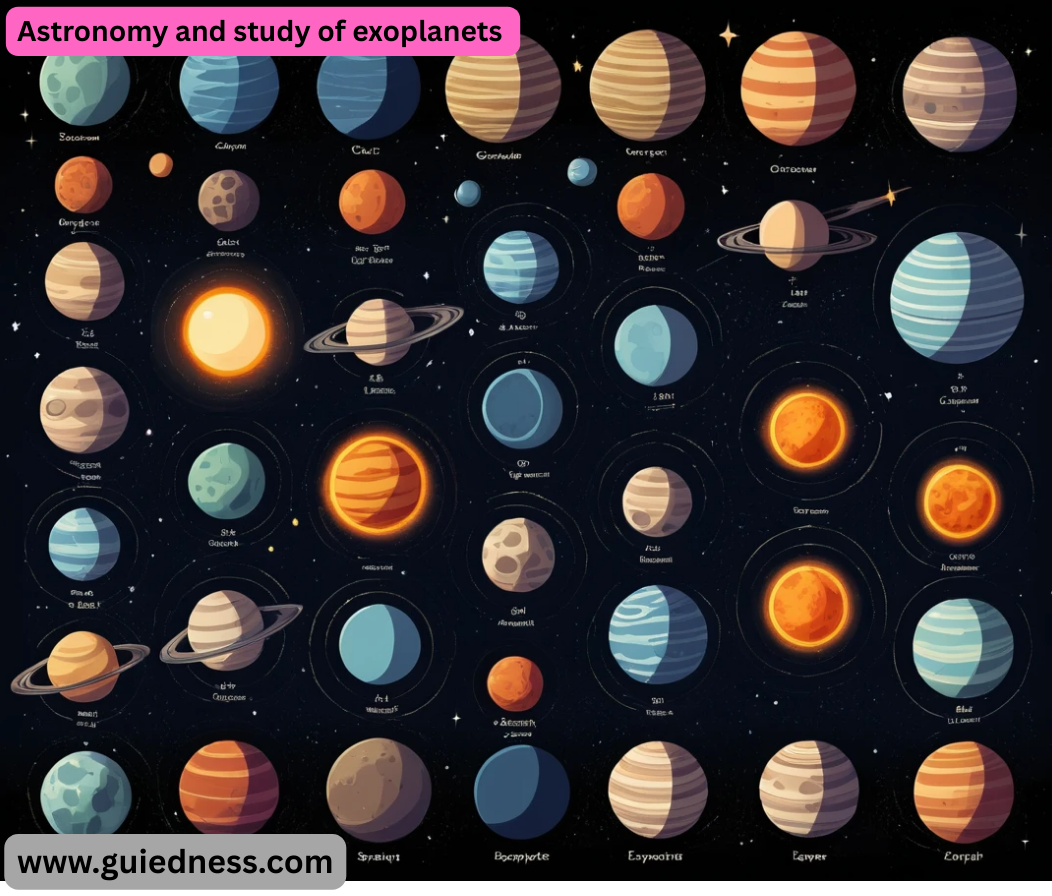
Astronomy and study of exoplanets Of course. It has transformed our understanding of planetary systems and our place in the universe. Here’s a comprehensive overview of the astronomy and study of exoplanets.
What is an Exoplanet?
- An exoplanet (or extrasolar planet) is a planet that orbits a star outside our Solar System. The term can also include planets that are free-floating in
space without a host star, known as rogue planets.
- A Brief History: From Speculation to Discovery
Ancient Philosophy: The idea of other worlds has existed since ancient Greek philosophers. - 1992: The first confirmed exoplanet discovery was a shock. Astronomers Aleksander Wolszczan and Dale Frail found two (and later a third) planets orbiting a pulsar (PSR B1257+12), the ultra-dense, rapidly spinning corpse of a dead star. This proved planets could exist in incredibly harsh environments.
- This was the first planet found orbiting a Sun-like star. It was a “Hot Jupiter”—a gas giant orbiting incredibly close to its star, defying all existing planetary formation theories. This discovery won them the 2019 Nobel Prize in Physics.
- 2009-2018: The Kepler Era: NASA’s Kepler Space Telescope was a revolutionary mission designed to find Earth-sized planets in the habitable zones of their stars. It used the transit method (see below) and monitored over 150,000 stars in a single patch of sky. It revealed that:
Planets are more common than stars.
Present Day: Missions like NASA’s TESS (Transiting Exoplanet Survey Satellite) and the James Webb Space Telescope (JWST) are now leading the charge. TESS is surveying the entire sky for nearby exoplanets, and JWST is analyzing their atmospheres in unprecedented detail.
How Do We Find Exoplanets? (Detection Methods)
It’s incredibly difficult to see an exoplanet directly—they are billions of times fainter than their host stars and are lost in the glare. Astronomers use indirect methods to detect them:
Radial Velocity (or Doppler Method):
As the star moves towards us, its light is blueshifted; as it moves away, it is redshifted. By measuring these shifts in the star’s spectrum, astronomers can detect the planet.
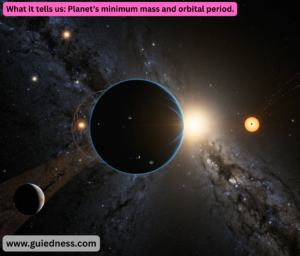
What it tells us: Planet’s minimum mass and orbital period.
Transit Method:
- How it works: If a planet’s orbit is aligned edge-on from our viewpoint, it will pass in front of its star, causing a tiny, periodic dip in the star’s brightness.
- What it tells us: Planet’s diameter. Combined with radial velocity data, we get its density (rocky vs. gaseous). This is the most prolific discovery method.
Direct Imaging:
- How it works: Using advanced coronagraphs or starshades to block the star’s blinding light, allowing the much fainter planet to be seen directly.
- Challenges: Extremely difficult; best for young, hot, very large planets orbiting far from their stars.
- Astronomy and study of exoplanets What it tells us: The planet’s brightness, spectrum, and some atmospheric properties.
Gravitational Microlensing:
How it works: Uses the gravity of a foreground star to act as a lens, magnifying the light of a background star. If the foreground star has a planet, it can cause a detectable blip in the magnification.
- Strength: Excellent for finding planets at a wide range of orbital distances, even rogue planets.
Astrometry:
- How it works: Precisely measures the star’s position in the sky, looking for the tiny wobble induced by an orbiting planet.
- Status: Historically very difficult, but upcoming space missions (like Gaia) are expected to find many planets this way.
Characterization: From Detection to Understanding
- Finding a planet is just the first step. The real science is in characterizing it:
- Atmosphere: When a planet transits, some starlight filters through its atmosphere. By analyzing this light with a spectrograph, we can identify the chemical fingerprints of gases like water vapor (H₂O), methane (CH₄), carbon dioxide (CO₂), and sodium (Na). The JWST is a master of this.
- The Habitable Zone (HZ): The region around a star where temperatures could allow liquid water to exist on a planet’s surface.
- Planetary Properties: A rocky composition (like Earth, not a gas giant) and a potential protective atmosphere are also considered crucial.
- Biosignatures: This is the next frontier. Scientists are searching for atmospheric chemicals that are potential signs of life, such as a combination of oxygen and methane, which on Earth are largely produced by biology.
Why is the Study of Exoplanets Important?
- Understanding Our Origins: How do planetary systems form and evolve? Is our Solar System typical or an outlier?
- The Search for Life: This is the ultimate goal. Are we alone in the universe? Finding a second example of life would be one of the most profound discoveries in human history.
- Planetary Diversity: Exoplanets have shown us a zoo of bizarre worlds: “Super-Earths,” “Mini-Neptunes,” “Hot Jupiters,” “Carbon Planets,” and “Lava
- Worlds.” This diversity challenges and enriches our theories.
- Future Humanity: While highly futuristic, understanding other planetary systems is the first step toward any potential long-term future among the stars.
The “Zoo” of Exoplanets: A Menagerie of Worlds
- The diversity of exoplanets is staggering, with many types that don’t exist in our own solar system:
- Hot Jupiters & Hot Neptunes: Gas giants orbiting perilously close to their stars, with years lasting only days and surface temperatures in the thousands of degrees. Their existence forced a complete revision of planetary formation models (planets can migrate inward after forming).
- Super-Earths & Mini-Neptunes: Planets between 1.6 and 4 times the size of Earth. The critical question is: are they large, rocky “super-Earths” or small, gaseous “mini-Neptunes” with thick hydrogen
atmospheres? This is a major area of research.
- Ocean Worlds & Hycean Planets: Theoretical classes. Ocean worlds are planets with global liquid water oceans under an icy shell (like Europa, but planet-sized). Hycean planets are a hypothetical type of hot, water-covered planet with a hydrogen-rich atmosphere, proposed as a promising candidate for harboring life.
- Rogue Planets (Planetary Mass Objects): Planets untethered to any star, wandering the cold darkness of interstellar space. They may outnumber stars in our galaxy. Some could have liquid water oceans beneath ice shields, heated by internal radioactivity.
- Astronomy and study of exoplanets Pulsar Planets: The first ever discovered, these planets orbit the dead, radioactive remains of a supernova. They are bathed in intense radiation, making
them incredibly hostile.
- Circumbinary Planets: Planets that orbit two stars at once, like Tatooine from Star Wars. Kepler found several, proving that stable orbits in such complex systems are possible.
- Pushing the Frontier: Key Questions and Techniques
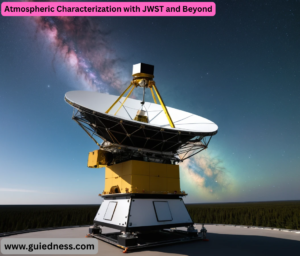
Atmospheric Characterization with JWST and Beyond
- Transmission Spectroscopy: When a planet transits, starlight filters through its atmosphere. Molecules in the atmosphere absorb light at specific wavelengths. JWST’s powerful infrared spectrographs create a spectrum of the atmosphere, revealing its chemical composition.
- Emission Spectroscopy: JWST can directly detect the thermal glow of some exoplanets (especially Hot Jupiters). By observing the dip in light as the planet passes behind the star (secondary eclipse), it can measure the planet’s temperature and even map its day-night temperature distribution.
- Phase Curves: By observing a planet throughout its entire orbit, JWST can measure how its brightness changes, revealing details about its weather, cloud cover, and atmospheric circulation.
The Hunt for Biosignatures
- This is the search for atmospheric gases that could indicate biological processes. It’s incredibly complex because:
False Positives: Abiotic (non-life) processes can produce gases we associate with life. For example, volcanic activity can produce methane, and photochemical reactions can produce oxygen. The key is to look for chemical disequilibrium—a combination of gases that shouldn’t coexist for long
The Direct Imaging Challenge
- Future missions aim to directly image and spectroscopically analyze Earth-like planets in the habitable zone. This requires:
- Extreme Coronagraphy: Advanced starlight-blocking instruments on large space telescopes.
- Starshades: A separate, giant, flower-shaped spacecraft that would fly tens of thousands of kilometers in front of a space telescope and precisely block the light of a star, allowing the telescope to see its planets directly.