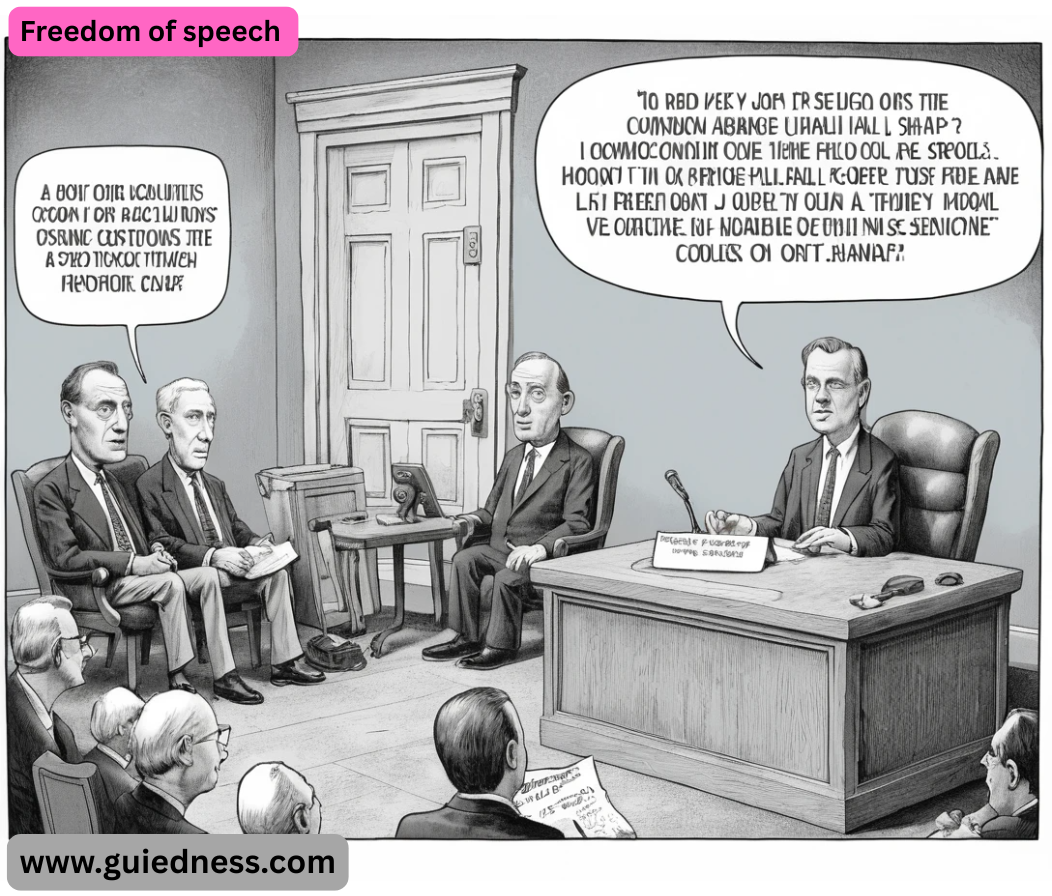
Freedom of speech Freedom of speech is a fundamental human right that allows individuals to express their opinions, ideas, and beliefs without fear of government censorship or retaliation. It is protected in many countries by laws, constitutions, and international agreements, such as the First Amendment in the U.S.

Key Aspects of Freedom of Speech:
- Expression Without Censorship – People can speak, write, or share ideas without government interference.
- Press Freedom – Media can report news and criticize authorities without prior restraint.
- Artistic & Creative Freedom – Artists, writers, and filmmakers can express themselves freely.
- Political Speech – Citizens can criticize leaders, protest, and advocate for change.
- Academic Freedom – Scholars and students can research and debate ideas openly.
Limitations & Responsibilities:
- While freedom of speech is broad, it is not absolute. Many countries impose restrictions to prevent harm, such as:
- Incitement to violence or hate speech
- Defamation (false statements harming reputation)
- Obscenity or child exploitation material
- National security threats (e.g., leaking classified info)
Debates & Challenges:
- Online Speech & Social Media – Should platforms regulate hate speech and misinformation?
- Cancel Culture – Does public shaming suppress free expression?
- Hate Speech vs. Free Speech – Where should the line be drawn?
Why It Matters:
- Encourages democracy & accountability
- Promotes innovation & progress through open debate
- Protects minority voices from oppression
Key Moral Questions on Free Speech:
- Should All Speech Be Free, Even If It’s Immoral?
- Absolutist View (e.g., U.S. First Amendment):
- “No government should restrict speech, even if offensive—truth emerges from open debate.”
- Example: Allowing racist speech, so society can confront and reject it.
Moral Restrictionist View:
- “Some speech (e.g., hate speech, lies causing harm) is inherently wrong and should be limited.”
- Example: Germany bans Nazi propaganda; many countries criminalize Holocaust denial.

Does Free Speech Override Harm?
Moral Harm Principle (J.S. Mill):
- Speech should be free unless it directly incites violence or causes measurable harm.
- Critique: Who defines “harm”? Emotional distress, reputational damage, or societal division may not always be legally actionable but are morally significant.
Cultural Relativism vs. Universal Morality:
- In liberal democracies, blasphemy may be protected, but in religious societies, it can be morally (and legally) forbidden.
- Example: Cartoons of the Prophet Muhammad (protected in France, banned in Pakistan).
Corporate Morality & Deplatforming:
- Should private platforms (Twitter, Facebook) enforce moral rules beyond legal requirements?
- Example: Banning misinformation—ethical responsibility or censorship?
The Core Tension: Rights vs. Ethics
- Legal Free Speech: Governments protect expression (with exceptions like incitement, defamation).
- Moral Free Speech: Societies (or individuals) impose unofficial consequences for “immoral” speech (e.g., boycotts, social shaming).
Example:
- Legally: A racist rant in public may be protected in the U.S.
- Morally: The speaker could be fired, ostracized, or deplatformed.
- Question: Is it fair to punish speech that’s legally allowed but morally condemned?
Where Do Moral Limits Come From?
- Different ethical frameworks justify (or reject) speech restrictions:
A. Utilitarianism (“Greatest Good”)
- Restrict speech if it causes net harm.
- Banning false medical advice (e.g., “Vaccines kill”).
- Could suppress minority opinions that later prove true.
B. Deontology (“Duty-Based Ethics”)
- Some speech is inherently wrong, regardless of consequences.
- Banning child exploitation content—even if no direct harm is proven.
- Hard to define universal moral rules (e.g., is blasphemy always wrong?).
C. Virtue Ethics (“What Would a Good Person Do?”)
- Speech should align with moral character.
- Encouraging kindness, condemning cruelty.
- Subjective—different cultures value different virtues.
Modern Controversies: Where Morality Clashes with Free Speech
A. Hate Speech
- Moral Argument for Banning: Prevents harm to marginalized groups.
- Free Speech Argument: Censorship sets dangerous precedent; counter-speech is better.
- Example: Germany bans Nazi symbols; U.S. allows them but counters with education.
B. Misinformation
- Moral Argument for Restriction: Lies can get people killed (e.g., anti-vaxxers, election fraud claims).
- Free Speech Argument: Who decides truth? Governments/media have biases.
C. Cancel Culture
- Moral Argument: Holding people accountable for harmful speech.
- Free Speech Argument: Mob justice chills dissent; no due process.
D. Religious vs. Secular Morality
- In secular democracies, blasphemy is often protected.
- In religious societies, insulting faith may be criminalized.
Possible Middle Ground?
- Some propose “Ethical Free Speech”—allowing legal expression but encouraging responsibility:
- No government censorship (to prevent tyranny).
- Social consequences for harmful speech (e.g., criticism, boycotts).
- Promote counterspeech over suppression.
But problems remain:
- Who defines “harmful”?
- Does this lead to self-censorship out of fear?
Final Debate: Should Morality Limit Speech?
Arguments FOR Limits:
- Protects vulnerable groups from harm.
- Upholds communal values over individualism.
- Prevents chaos (e.g., lies leading to violence).
Arguments AGAINST Limits:
- Morality is subjective—who gets to decide?
- Historically, “moral” censorship targeted civil rights, LGBTQ+ voices, etc.
- Truth suffers when dissent is silenced.
Historical Precedents: Lessons from the Past
Examining three pivotal moments:
A. 399 BC – Trial of Socrates
- Moral Crime: Corrupting youth + impiety
- Outcome: Death sentence
- Modern Parallel: Professors fired for controversial teachings
B. 1933 – Nazi Book Burnings
- Moral Justification: “Cleansing” German culture
- Result: Precursor to genocide
- Modern Parallel: Calls to ban “harmful” books in schools
C. 1989 – Salman Rushdie Fatwa
- Moral Claim: Defending Islam
- Consequence: Global terror campaign
- Modern Parallel: Charlie Hebdo attacks
- Pattern Recognition: Moral censorship often escalates beyond original intentions.
Future Projections: Emerging Battlegrounds
Coming conflicts in speech morality:
A. AI-Generated Content
- Deepfake porn vs. synthetic political speech
- Who bears moral responsibility?
B. Neurotechnology
- Brain-computer interface thought policing
- Can “mental speech” be regulated?
C. Interplanetary Communication
- Mars colony speech codes
- Offending Earth cultures from space
The Ultimate Test: A Moral Decision Matrix
When evaluating whether to restrict speech, ask:
- Harm Certainty: Is the damage provable and imminent?
- Enforcer Legitimacy: Does the restricting entity have moral authority?
- Alternative Solutions: Could counterspeech work better?
- Slippery Slope Risk: Could this precedent be abused later?
- Cultural Context: Is this restriction appropriate for this society?
The “Hierarchy of Harm” Test
- Freedom of speech Not all harmful speech is equal. We can prioritize restrictions using a severity scale:
- Imminent Physical Harm (e.g., inciting riots) → Almost always banned
- Psychological/Dignitary Harm (e.g., targeted harassment) → Often restricted
- Offense/Discomfort (e.g., blasphemy, crude art) → Rarely restricted
Problem: Who defines “harm”?
- Feminists may argue pornography harms women.
- Libertarians counter that it’s a victimless act.
Cultural Relativism vs. Universal Rights
- Scenario: A comedian insults religion.
- Secular Western View: Protected speech (morality ≠ legality).
- Conservative Religious View: Blasphemy is immoral and should be illegal.
Can universal free speech exist?
- The U.N. declares free speech a human right—but 32% of countries criminalize blasphemy.
The “Marketplace of Morals” Experiment
Imagine three societies with different systems:
- Absolute Free Speech (No moral limits) → Result: More innovation but also more harm (e.g., 4chan).
- Moral Guardianship (Speech policed by elites) → Result: Less hate but stagnation (e.g., Victorian England).
- Ethical Pluralism (Community-based norms) → Result: Balance but inconsistency (e.g., moderating Reddit forums).
- Which works best? Depends on whether you prioritize liberty or harmony.